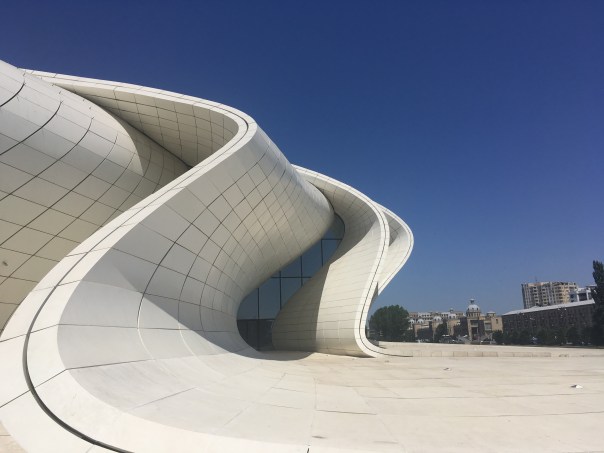
On the promenade by the Caspian, everything seems to be made of marble, even the underground passageway that leads to it from underneath the boulevard. Once you emerge, Russian ballet music is coming from somewhere: speakers mounted in light posts, it turns out. A sparkling white fountain is populated by statues of swans. All along the promenade runs a grassy park shaded with trees and lined with benches. One section of the promenade is called “Little Venice”: you go up and down over more marble steps above a network of canals where gondoliers row visitors in the twilight. At the far end of the promenade is an enormous, flower-shaped architectural wonder known as the pearl. Beyond that, around a bend, is a giant, glittering ferris wheel.
At nightfall, around nine o’clock, the promenade is at its most crowded, especially around the fountain of swans. The open plaza yields a good view up and away from the Caspian toward the “Flame Towers.” Once it’s dark, these three high-rises light up in undulations of red-orange, then sea-blue. (Or is it gas-flame blue? This is oil-rich Azerbaijan, after all.) Now each tower takes on its own color: one blue, one red, one green, the colors of Azerbaijan’s flag. After another minute, the image changes to a giant white-on-black silhouette of a heroic figure waving that flag. All around the fountain of swans, people are taking selfies with these images as backdrop, the music as soundtrack.
It’s something else (really, check it out), which I mean not as a figure of speech but as literally unlike anything I’ve ever seen. Baku might be the city of the future, yet perhaps the future it’s the city of will never come to be; if it does, it will have no America in it, because no American city has even begun to remake itself in the twenty-first-century image that cities like Baku are shaping. More and more, America seems to me a place caught between two eras: detached from the traditionalism that gives durable cultures the lifeblood that sustains them through epochal change (for example, in the part of Georgia we’re in now, they’ve been making wine the same semi-primitive way for hundreds if not thousands of years); but lagging way behind the innovation and reimagining that mark the vanguard of civilization. It sometimes seems plausible that the US is so stuck on and in itself, so paralyzed by its divisions and addictions, and still so pitiably longing for the late twentieth century (i.e. the time before 9/11 that we will wake up one day to find that the world we thought we were leading has taken an alternate and faster route to some completely different destination and left us still driving our cars to nowhere while civilization is soaring up and away to heights undreamt.
Meanwhile, as Baku leaps, probably too quickly, toward the future, there are so many metaphors for/symbols of its paradoxes of simultaneous obviousness and indecipherability, of novelty and backwardness, of stylishness and awkwardness, authenticity and counterfeit, wealth and poverty, that you’d have to be asleep not to notice them. Here are a few:

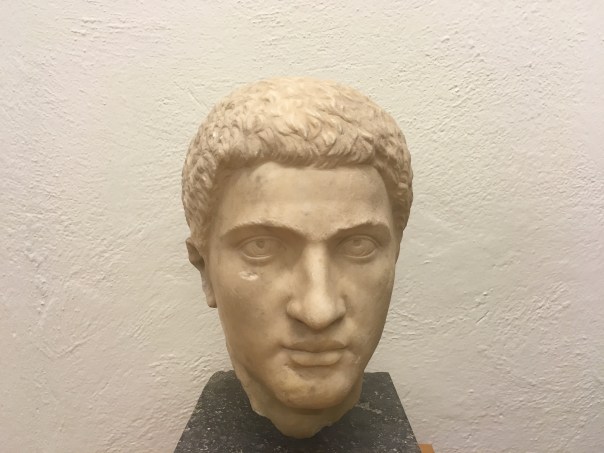 My determination to see Apollonia was a bit like my attraction to Përmet when I read about it in my guidebook. I wasn’t sure exactly why, but simply gazing at a single picture convinced me. A week ago Friday morning, I went to the Berat bus station with my daypack, filled with a surprise bag of snacks courtesy of my guesthouse hostess, Theodhora, whose generosity and thoughtfulness never failed to catch me off guard. I caught a minibus to Fier, a rather drab slab of urbanity that would seem to be utterly skippable; Gillian Gloyer’s Albania guidebook completely omits it except in very occasional mentions as a place from which to connect to other buses elsewhere: it’s a place you go in order to get out of it. (Part of me can’t help suspecting that guidebook authors will sometimes omit a country’s less obvious gems out of protectiveness or possessiveness, concealing them from overuse by tourists, but I don’t think that’s the case with Fier.) From Fier it’s a short ride to a village called Pojan, and from Pojan you can walk to Apollonia in less than half an hour.
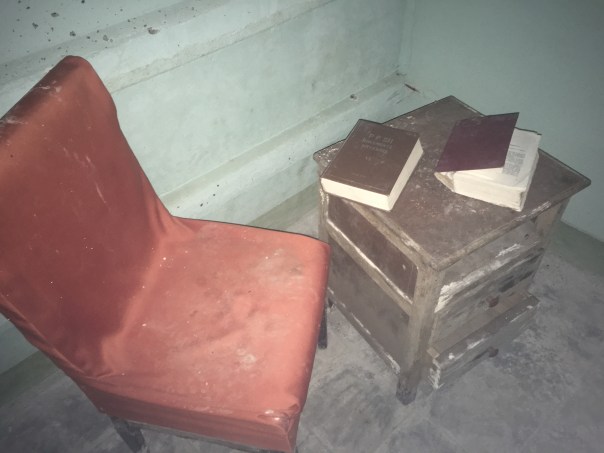 Enver Hoxha, Albania’s dictator from just after World War II until his death in 1985, was born in Gjirokastra. So was Ismail Kadare, Albania’s most famous writer—but to call him that is to undershoot by miles. To the rest of the world, Kadare is Albania’s only famous writer, although that doesn’t make him beyond compare. Think of someone like Mario Vargas Llosa, Peru’s only well-known literary export.
 In the afterword to Lolita, Nabokov enumerates some very minor details of the novel, a few of them just a sentence or even a mere word, that most readers will have probably not even noticed. He calls these “the nerves of the novel. These are the secret points, the subliminal coordinates by means of which the book is plotted.”
 sobsey